

by Lara Eleni Rögele (2025)
Every winter season, department stores from London to Berlin turn their windows into winter stages, while the perfect gift is only one click away. And yet, crowds still stop in the cold to look at glass. What goes through their minds before anyone decides to step inside?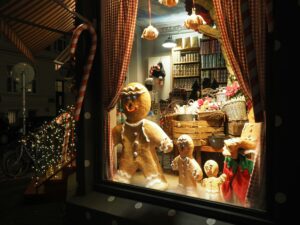
Store windows are among the most important communication tools of brick-and-mortar retail, even though many retailers are shifting budgets towards e-commerce. Passers-by’s attention must be captured within seconds at the physical Point of Sale (PoS). Therefore, store window displays have always served as a store’s „calling card”, providing product information, building brand image, and evoking emotional reactions.
Research has mostly focused on entry and purchase intentions, and much less on what happens before that, when a passer-by decides whether a window is attractive at all. This study therefore asks how the perceived creativity of a store window affects its perceived attractiveness, and whether the feel-good state mediates this link.
A second model tests the degree to which the following four distinct value dimensions explain and mediate the formation of this feel-good state: (1) hedonic value – emotional aspects like the enjoyment of looking (2) informative value – what the window tells about products, brands and trends (3) social value – social approval, belonging and positive reactions and (4) image-related value – what the window says about the perception and image of the store.
The study was an online survey conducted under laboratory conditions. 75 participants rated eight photographs of store windows from different retail sectors in Stuttgart’s city centre. Two mediation analyses were run, in which mood and brand familiarity were considered as covariates.
Creativity makes windows attractive, largely through emotion. Perceived creativity strongly predicted perceived display attractiveness. The feel-good state carried a large share of this effect. Because the direct effect remained significant, the mediation is partial. It is likely that other mediators are also at play.
Image, hedonic and social value explain the feeling, information does not. Creativity raised all four values, but only three of them transmitted its effect on the feel-good state. Image-related value was the strongest mediator, followed by hedonic and social value. Informative value did not contribute.
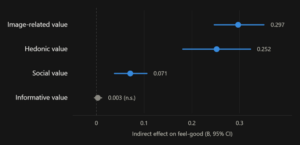
Indirect effects of perceived creativity on the feel-good state via the four values (blue: significant effects, grey: non-significant one)
Is there such a thing as “too creative”? After the four values were included, the direct effect of creativity on feel-good turned slightly negative. This could point to overstimulation at high levels of novelty, in line with the “sweet spot” of an inverted-U relationship. A linear model cannot test this, so it remains a hypothesis for future research.
As with any study, there are limitations. The sample was young, almost entirely students, and 61% female. The small and subjectively selected set of eight window displays, and the use of static digital images cannot fully capture the real-world sensory experience. Additionally, attractiveness and feel-good were each measured with a single self-developed item. Finally, the correlational design does not allow causal conclusions. The findings should therefore be considered preliminary and explored in future research.
And for retail: What does a creative window say about the store? The findings show that they can strengthen brand perception and evoke positive emotional responses. Image-related and hedonic value were the strongest routes to the feel-good state. A creative window signals that a store is up to date, has taste and puts effort into its customers, and it offers a small moment of enjoyment that passers-by transfer to the store itself. Retailers should therefore treat windows as active outdoor advertising and focus on emotional storytelling, originality and aesthetic appeal, adapted to their target audience, rather than on simple product presentation. Effective displays do not necessarily require large budgets. Unusual concepts and a few carefully selected props can already create a strong impact.
Creativity is more than decoration. Creative windows work through the feelings and the image they create. This is a real advantage for physical stores in an age of online shopping. Which specific design elements make a window “creative enough” remains to be tested. Whether on a winter stage or in a side street, a window makes passers-by feel something before they step inside, and creativity helps decide what that feeling is.
References
Berlyne, D.E. (1970). Novelty, complexity, and hedonic value. Perception and Psychophysics, 8, 279-286.
Hoffmann, S. (2025). Schau, Fenster im KaDeWe. Verfügbar unter: https://www.gallery-weekend-berlin.de/journal/kadewe-schau-fenster/
Jain, V., Takayanagi, M., Malthouse, E.C. (2014). Effect of show windows on fe male consumers‘ shopping behaviour. Journal of Consumer Marketing, 31(5), 380-390. http://dx.doi.org/10.1108/JCM-04-2014-0946
Lange, F., Rosengren, S. & Blom, A. (2016). Store-window creativity’s impact on shopper behavior. Journal of Business Research, 69(3), 1014-1021. https://doi.org/10.1016/j.jbusres.2015.08.013
Lenz, A. (2019). Window Shopping in London. Verfügbar unter: https://www.textilwirtschaft.de/fashion/visual-merchandising/fruehjahrs schaufenster-top-5-die-schaufenster-der-londoner-department-stores-214556
Schwarz, N. & Clore, G. (1983). Mood, misattribution, and judgements of well being: Informative and directive functions of affective states. Journal of Perso nality and Social Psychology, 45(3), 513-523. DOI: 10.1037/0022 3514.45.3.513