
Who decides matters! How AI in HR affects employee commitment

by Nicola Maisch (2026)

Monday, 8:47 a.m. – An email lands in your inbox. Your application for the company’s talent development programme has been decided – you have been rejected. But who really made that decision? How does it affect you? And how does it make you feel about your employer?

AI is increasingly used across the entire employee lifecycle in HRM, promising greater efficiency and standardisation. But when technology becomes involved in decisions about people, a crucial question arises: How do they perceive these decisions?
Therefore, this study investigates whether perceived use of AI-supported HR systems affects employees’ affective organizational commitment and whether the perception of procedural fairness mediates this relationship. Two further factors were examined as possible moderators: perceived transparency and employees’ general trust in technology.

The study was designed as a quantitative online experiment. A total of 192 employed participants were randomly assigned to one of four scenarios involving selection for an internal talent development programme. They rated procedural fairness, trust in technology, and affective organizational commitment.
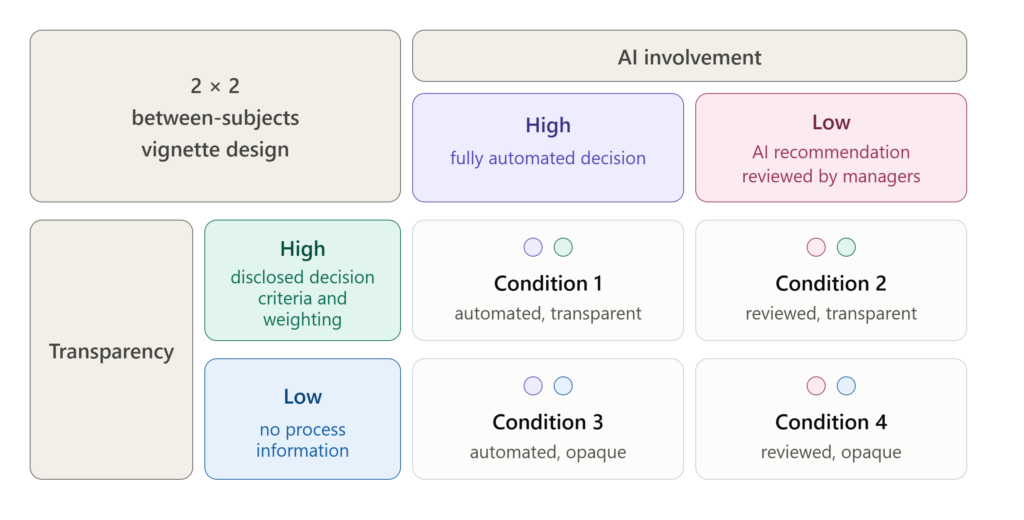
AI itself may not be the problem. Interestingly, AI involvement itself had no significant direct effect on affective commitment. Employees did not feel less attached to their organization because an algorithm was involved. However, how the decision was made mattered. Fully automated decisions were perceived as less procedurally fair than decisions with manager oversight. Higher perceived fairness, in turn, was linked to stronger affective commitment.

Keep the human in the loop. The expected mediation was not confirmed in the overall model, but exploratory analysis showed a significant indirect effect through procedural fairness, supporting the Organizational Justice Theory. Employees respond to the decision process rather than to the technology behind it, so AI should not be seen as a yes-or-no question. Decision autonomy can be understood as a continuum from AI as decision support to AI as decision maker. Human oversight appears to play a key role in how fair such processes are perceived.

Other fairness criteria may be affected by automation. The study also tested whether perceived transparency changes the relationship between AI involvement and procedural fairness, and whether trust in technology influences the relationship between fairness and organisational commitment. Neither moderating effect was statistically significant. However, trust in technology independently predicted affective commitment positively.

The study has a few limitations. It relied on hypothetical scenarios and a small, specific sample, measured commitment only as an immediate reaction, and captured fairness without voice or appeal options. The results are therefore more of an initial indication than a definitive answer. Future research should replicate them with larger, more diverse samples and in real-world HR settings over time.

What does this mean for HR? Decision-process design and perceived fairness may matter more than the mere presence of AI. Organisations introducing AI-supported HR systems should (1) keep humans in the loop for consequential, people-centred decisions, (2) ensure transparency by communicating decision criteria and data use, and (3) build trust by explaining HR systems, monitoring reliability, introducing them gradually, and allowing employees to gain experience.

We need to look beyond the technology. Employees’ responses to AI-supported HR systems depend less on whether AI is used and more on how it is used. Fair, comprehensible decision-making processes and an appropriate balance between human and technological decision authority could be key to ensuring that AI supports organisations without undermining employees’ sense of fairness and commitment.

References

Allen, N. J., & Meyer, J. P. (1996). Affective, continuance, and normative commitment to the organization. Journal of Vocational Behavior, 49(3), 252–276. https://doi.org/10.1006/jvbe.1996.0043

Bankins, S., Formosa, P., Griep, Y., & Richards, D. (2022). AI decision making with dignity? Contrasting workers’ justice perceptions of human and AI decision making in a human resource management context. Information Systems Frontiers, 24(3), 857–875. https://doi.org/10.1007/s10796-021-10223-8

Colquitt, J. A. (2001). On the dimensionality of organizational justice: A construct validation of a measure. Journal of Applied Psychology, 86(3), 386–400. https://doi.org/10.1037/0021-9010.86.3.386

Lee, J. D., & See, K. A. (2004). Trust in automation: Designing for appropriate reliance. Human Factors, 46(1), 50–80.
https://doi.org/10.1518/hfes.46.1.50_30392

Robert, L. P., Pierce, C., Marquis, L., Kim, S., & Alahmad, R. (2020). Designing fair AI for managing employees in organizations: A review, critique, and design agenda. Human–Computer Interaction, 35(5–6), 545–575. https://doi.org/10.1080/07370024.2020.1735391

Trusting the Machine: How Autonomy and Interaction Design Shape Confidence in AI Financial Advice

Artificial intelligence is no longer a futuristic vision but a tangible part of financial reality. Financial institutions increasingly rely on AI technologies for tasks ranging from credit scoring to fraud detection. Yet, the crucial question remains: How willing are people to delegate financial decision-making to machines?

The bachelor thesis by Svetlana Pobivanz examines how AI autonomy and communicative interaction design influence trust in AI-based investment advice, which is essential for the adoption of digital banking and robo-advisory services.


Research Objective:

The study investigates the role of AI system characteristics—autonomy and interaction style—on user trust. While previous research (Lee & See, 2004; Siau & Wang, 2018) highlighted trust as central to technology acceptance, this study extends this by considering the psychological and design-related factors affecting trust in financial AI.

Specifically, the research explores whether a semi-autonomous AI with user choice or a fully autonomous AI, and whether a human-like avatar or a text-based chatbot, can enhance perceived trustworthiness.


Method:

A 2×2 experimental design was employed with 197 participants who were randomly assigned to one of the four experimental conditions. Participants interacted with a fictional AI portfolio assistant simulating investment recommendations.

  • In the full-autonomy condition, the AI made decisions independently.
  • In the semi-autonomy condition, the AI offered three options for the user to select.
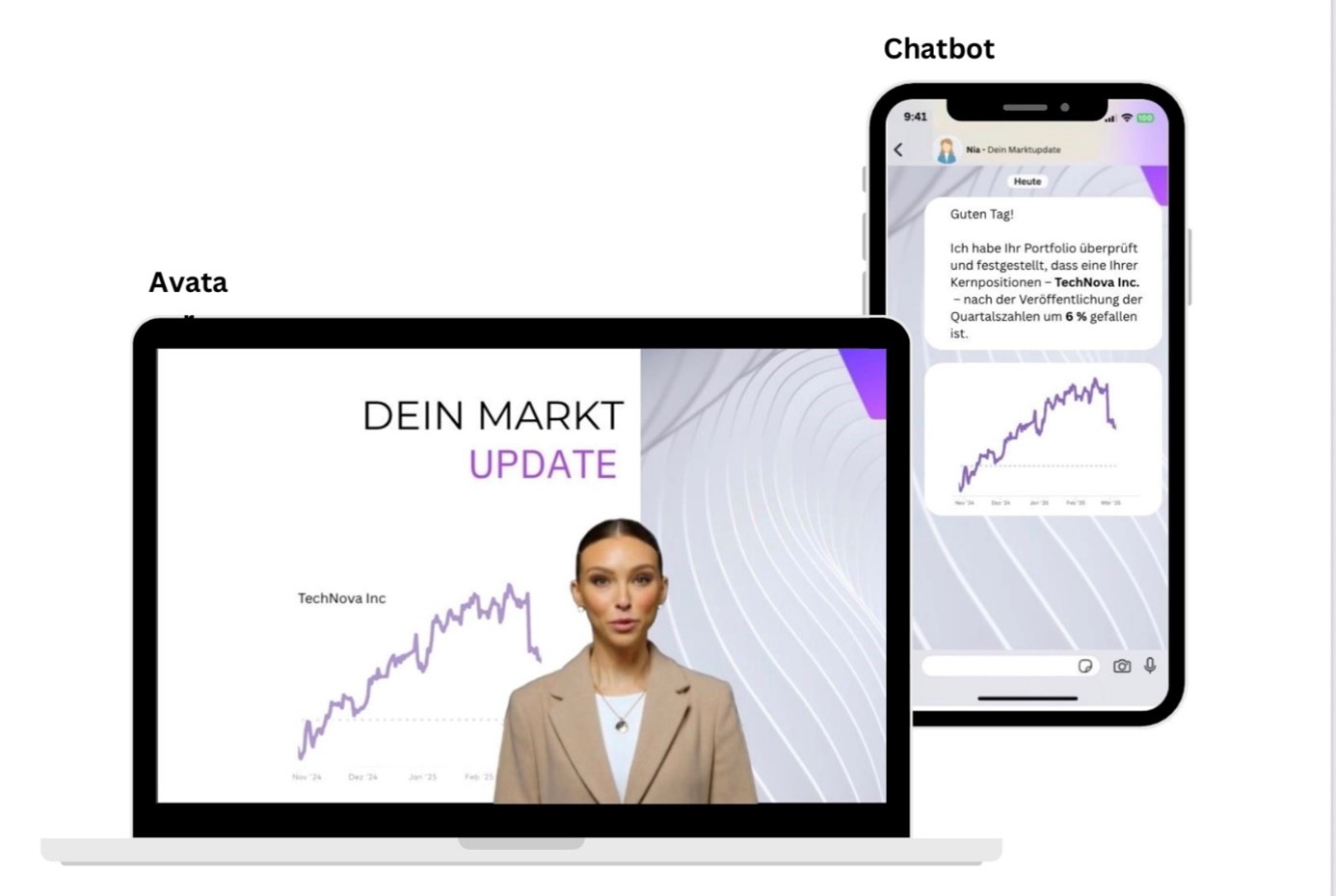
  • The interaction design varied between a human-like avatar capable of speech and facial expressions and a text-based chatbot.

Trust was assessed using the Trust in Automation Scale (Jian et al., 2000) and the Trust in Artificial Intelligence Scale (Hoffman et al., 2021), evaluating perceived reliability, competence, and transparency. 

Illustration of how the avatar and chatbot were displayed during the survey.


Key Findings:

Contrary to expectations, neither AI autonomy nor interaction design had a significant main effect on trust (p > .05). Descriptively, avatar-based advisors were perceived as slightly more personable, but this did not translate into significantly higher trust.

A regression analysis revealed that participants’ general attitudes toward AI were the strongest predictor of trust (b = .53; β = .45). Positive prior attitudes toward AI consistently led to higher trust, irrespective of system design. This aligns with the Technology Acceptance Model (Venkatesh & Davis, 2000), emphasizing trust as a key determinant of technology adoption.


Conclusion:

The results of the study show that trust in AI-supported investment advice depends less on interaction design or degree of autonomy. Neither avatars nor chatbots nor different levels of autonomy had a significant impact on trust. Although avatars are perceived as more likeable, this effect did not translate into greater trust.

Rather, the general attitude of users towards AI is decisive. It can be confirmed that trust is primarily created through transparency, traceability and comprehensible communication (Hoffman et al., 2023; Choung, David & Ross, 2023). User-friendly presentations can improve the experience, but they do not replace the need for clear explanations and education.

Overall, the results show that promoting knowledge, transparency and a positive attitude is key to building trust in AI-based investment advice and strengthening the acceptance of such systems in the long term.


References:

Choung, H., David, P., & Ross, A. (2023). Trust in AI and Its Role in the Acceptance of AI Technologies. International Journal of Human–Computer Interaction, 39(9), 1727–1739. https://doi.org/10.1080/10447318.2022.2050543

Hoffman, R. R., Mueller, S. T., Klein, G., & Litman, J. (2023). Measures for explainable AI: Explanation goodness, user satisfaction, mental models, curiosity, trust, and human-AI performance. Frontiers in Computer Science, 5, 1096257. https://doi.org/10.3389/fcomp.2023.1096257

Hoffman, R., Mueller, S. T., Klein, G., & Litman, J. (2021). Measuring Trust in the XAI Context. https://doi.org/10.31234/osf.io/e3kv9

Jian, J.-Y., Bisantz, A. M., & Drury, C. G. (2000). Foundations for an Empirically Determined Scale of Trust in Automated Systems. International Journal of Cognitive Ergonomics, 4(1), 53–71. https://doi.org/10.1207/S15327566IJCE0401_04

Lee, J. D., & See, K. A. (2004). Trust in Automation: Designing for Appropriate Reliance. Human Factors: The Journal of the Human Factors and Ergonomics Society, 46(1), 50–80. https://doi.org/10.1518/hfes.46.1.50_30392

Siau, K., & Wang, W. (2018). Building Trust in Artificial Intelligence, Machine Learning, and Robotics. 47https://www.researchgate.net/publication/324006061_Building_Trust_in_Artificial_Intelligence_Machine_Learning_and_Robotics

Venkatesh, V., & Davis, F. D. (2000). A Theoretical Extension of the Technology Acceptance Model: Four Longitudinal Field Studies. Management Science, 46(2), 186–204. https://doi.org/10.1287/mnsc.46.2.186.11926

Technology Acceptance Lab
Datenschutz-Übersicht

Please refer to our Data Protection Notice, which you find here:

Our Data Protection Guideline - Innovation Acceptance Lab