

by Nicola Maisch (2026)
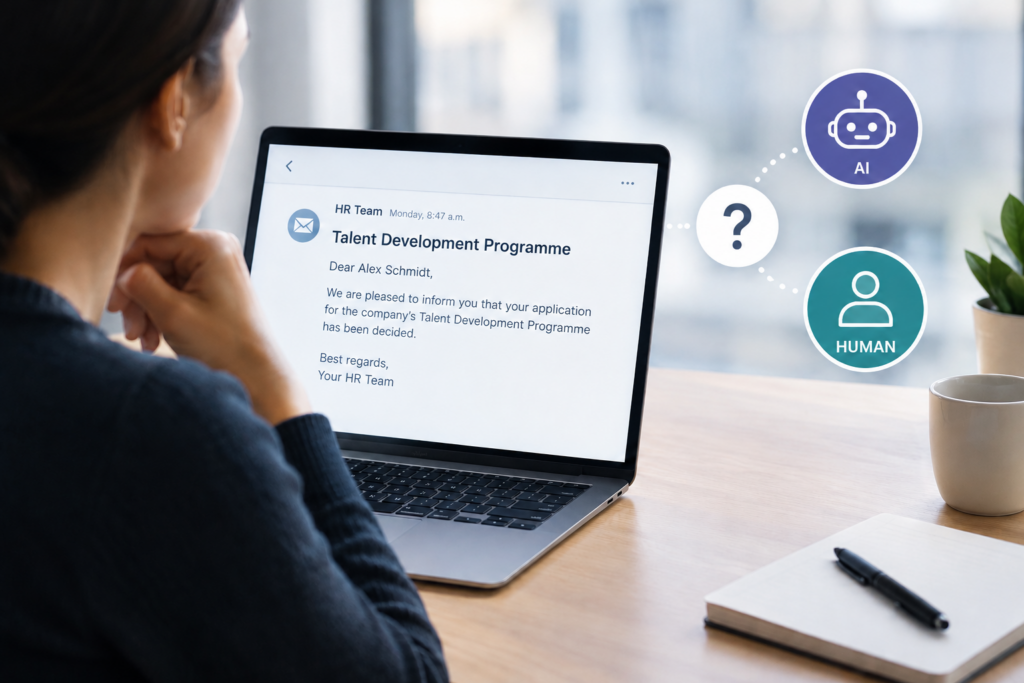
Monday, 8:47 a.m. – An email lands in your inbox. Your application for the company’s talent development programme has been decided – you have been rejected. But who really made that decision? How does it affect you? And how does it make you feel about your employer?
AI is increasingly used across the entire employee lifecycle in HRM, promising greater efficiency and standardisation. But when technology becomes involved in decisions about people, a crucial question arises: How do they perceive these decisions?
Therefore, this study investigates whether perceived use of AI-supported HR systems affects employees’ affective organizational commitment and whether the perception of procedural fairness mediates this relationship. Two further factors were examined as possible moderators: perceived transparency and employees’ general trust in technology.
The study was designed as a quantitative online experiment. A total of 192 employed participants were randomly assigned to one of four scenarios involving selection for an internal talent development programme. They rated procedural fairness, trust in technology, and affective organizational commitment.
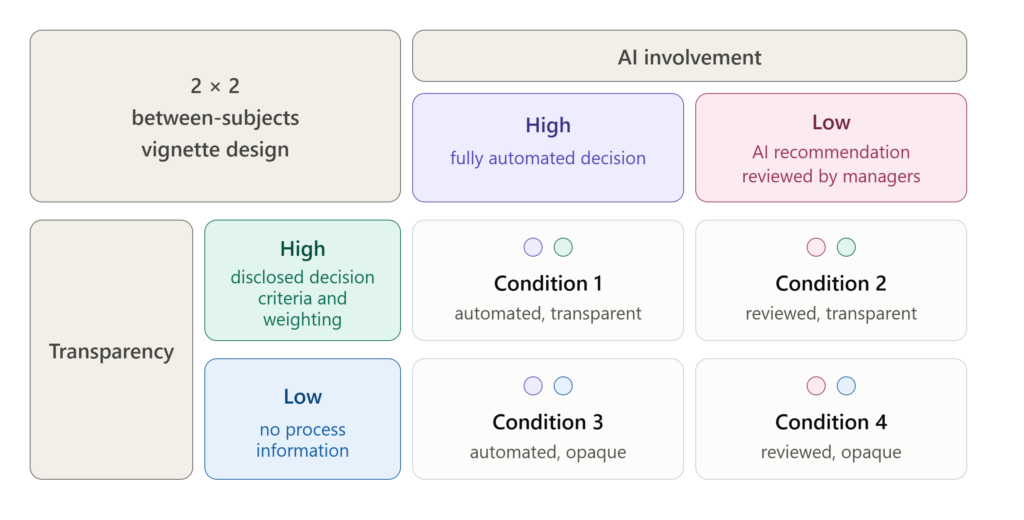
AI itself may not be the problem. Interestingly, AI involvement itself had no significant direct effect on affective commitment. Employees did not feel less attached to their organization because an algorithm was involved. However, how the decision was made mattered. Fully automated decisions were perceived as less procedurally fair than decisions with manager oversight. Higher perceived fairness, in turn, was linked to stronger affective commitment.
Keep the human in the loop. The expected mediation was not confirmed in the overall model, but exploratory analysis showed a significant indirect effect through procedural fairness, supporting the Organizational Justice Theory. Employees respond to the decision process rather than to the technology behind it, so AI should not be seen as a yes-or-no question. Decision autonomy can be understood as a continuum from AI as decision support to AI as decision maker. Human oversight appears to play a key role in how fair such processes are perceived.
Other fairness criteria may be affected by automation. The study also tested whether perceived transparency changes the relationship between AI involvement and procedural fairness, and whether trust in technology influences the relationship between fairness and organisational commitment. Neither moderating effect was statistically significant. However, trust in technology independently predicted affective commitment positively.
The study has a few limitations. It relied on hypothetical scenarios and a small, specific sample, measured commitment only as an immediate reaction, and captured fairness without voice or appeal options. The results are therefore more of an initial indication than a definitive answer. Future research should replicate them with larger, more diverse samples and in real-world HR settings over time.
What does this mean for HR? Decision-process design and perceived fairness may matter more than the mere presence of AI. Organisations introducing AI-supported HR systems should (1) keep humans in the loop for consequential, people-centred decisions, (2) ensure transparency by communicating decision criteria and data use, and (3) build trust by explaining HR systems, monitoring reliability, introducing them gradually, and allowing employees to gain experience.
We need to look beyond the technology. Employees’ responses to AI-supported HR systems depend less on whether AI is used and more on how it is used. Fair, comprehensible decision-making processes and an appropriate balance between human and technological decision authority could be key to ensuring that AI supports organisations without undermining employees’ sense of fairness and commitment.
References
Allen, N. J., & Meyer, J. P. (1996). Affective, continuance, and normative commitment to the organization. Journal of Vocational Behavior, 49(3), 252–276. https://doi.org/10.1006/jvbe.1996.0043
Bankins, S., Formosa, P., Griep, Y., & Richards, D. (2022). AI decision making with dignity? Contrasting workers’ justice perceptions of human and AI decision making in a human resource management context. Information Systems Frontiers, 24(3), 857–875. https://doi.org/10.1007/s10796-021-10223-8
Colquitt, J. A. (2001). On the dimensionality of organizational justice: A construct validation of a measure. Journal of Applied Psychology, 86(3), 386–400. https://doi.org/10.1037/0021-9010.86.3.386
Lee, J. D., & See, K. A. (2004). Trust in automation: Designing for appropriate reliance. Human Factors, 46(1), 50–80.
https://doi.org/10.1518/hfes.46.1.50_30392
Robert, L. P., Pierce, C., Marquis, L., Kim, S., & Alahmad, R. (2020). Designing fair AI for managing employees in organizations: A review, critique, and design agenda. Human–Computer Interaction, 35(5–6), 545–575. https://doi.org/10.1080/07370024.2020.1735391